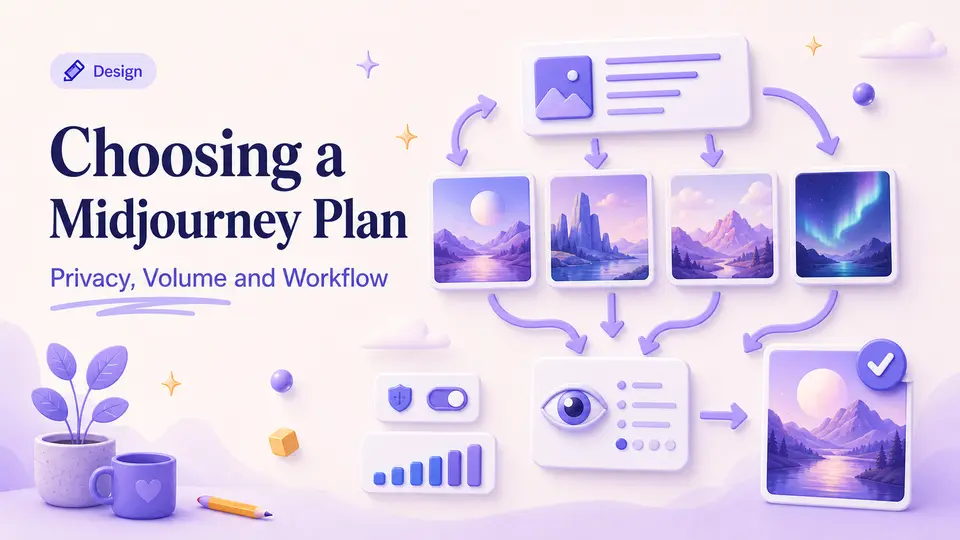
An art director produces a striking concept image after a few prompts and wants to use the same process for an unreleased client campaign. The creative result is promising, but the decision changes when confidential references, public visibility, usage rights, generation volume, and account ownership enter the brief. The image is only one part of the purchase case.
Midjourney is most useful when visual exploration is a recurring job and the buyer understands how the current tiers differ. Speed, processing mode, concurrency, privacy features, and provider terms can matter as much as image quality. A responsible buying guide therefore starts with the approved deliverable, tests the path required to create it, and refuses any marketplace offer that does not identify the actual tier and permitted account route.
The short answer
- Choose the tier from expected generation volume, speed, and privacy needs.
- Public visibility and usage rights require explicit review; they are not identical across situations.
- The offer should name the actual Midjourney tier and account path before you proceed.
Begin with the image work you need to complete
Midjourney is a strong candidate for exploring visual directions, producing concept art, testing compositions, and iterating from prompts or references. Decide what the images will be used for and how many viable options a project requires. A personal moodboard and a client campaign create very different review and rights obligations.
Build a small trial brief with a subject, composition, mood, output format, and acceptance criteria. Track the generations, variations, editing, and cleanup needed to reach a usable asset. The subscription is valuable when that process reliably improves ideation or production, not simply when an isolated result looks impressive.
Run a structured creative trial
Write one brief with a subject, audience, composition, mood, required format, source-reference rules, and acceptance criteria. Generate enough options to experience the normal process rather than stopping at the first attractive image. Track prompts, variations, processing mode, rejected directions, external editing, and the approvals needed before the asset can be used.
Repeat the trial with a second brief that is less forgiving: consistent characters, precise product details, readable text, or a series that must share a visual language. This exposes whether the tool supports the actual production requirement or only broad ideation. Keep confidential references out of the test until the account, visibility behavior, and organizational policy have been reviewed for the exact plan.
- Count viable concepts and approved deliverables, not total generations.
- Record how much retouching, layout, typography, and fact correction remains.
- Test consistency requirements that matter across a campaign or series.
- Separate creative exploration from private production and final asset delivery.
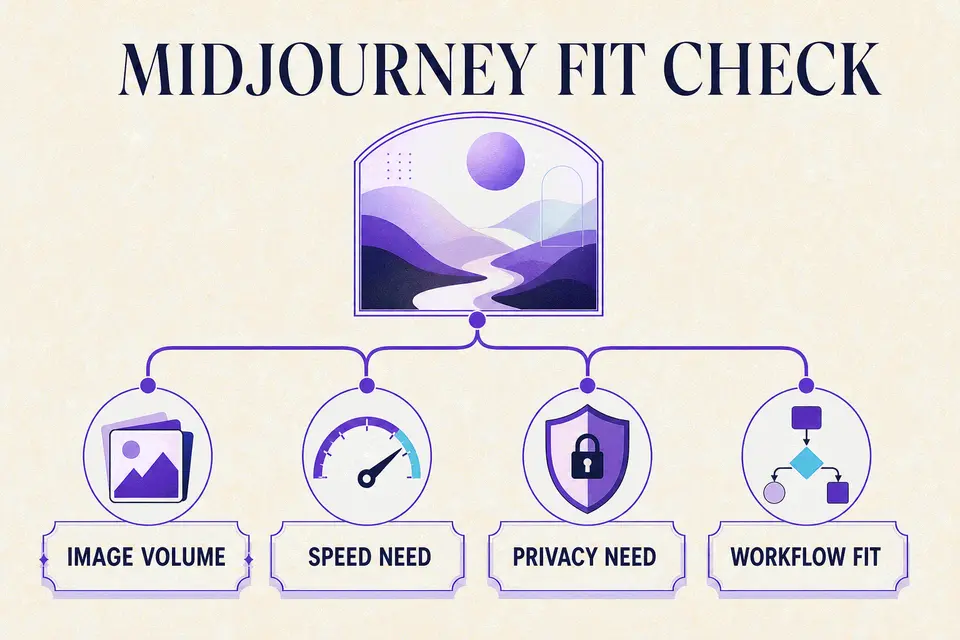
The subscription is valuable when that process reliably improves ideation or production, not simply when an isolated result looks impressive.
Taploop decision principle
Match the plan to allowances, speed, and privacy
Midjourney currently publishes Basic, Standard, Pro, and Mega subscriptions. Its official comparison distinguishes Fast GPU time, Relax Mode, concurrent work, video capabilities, and Stealth Mode. These differences are material, so a generic listing that says only Midjourney access does not identify what is being sold.
Estimate your monthly generation volume and whether slower background processing is acceptable. If private creation matters, verify the current Stealth Mode rules and public visibility behavior. Recheck the official comparison because plan features and allowances can change.
- Estimate Fast GPU time from representative projects, not guesswork.
- Check whether your tier supports the image or video mode you need.
- Confirm privacy behavior before uploading confidential references.
- Review renewal and upgrade rules for monthly and annual choices.
Confirm the account path and usage rights
The account should be controlled by the person or organization responsible for billing, source references, and resulting assets. Confirm whether the offer applies to an existing Midjourney account and whether the provider permits the represented access route. Do not accept credentials or an account-transfer method that conflicts with provider rules.
Review Midjourney's current terms for commercial work, company size, public visibility, and uploaded material. Generated images can also contain artifacts, unwanted brand resemblance, or inaccurate details. Human selection, editing, and legal review remain part of professional use.
Know when Midjourney is not a complete workflow
Midjourney may be a weak primary purchase when the real bottleneck is layout, brand governance, photo retouching, motion finishing, or multi-format publishing. It can create source material, but the buyer should count the other tools and people required to turn that material into an approved deliverable. A beautiful concept does not remove production dependencies.
It may also be unsuitable when the project requires privacy, rights treatment, or account control that the chosen tier and provider terms do not support. Review company-size and commercial-use requirements, public visibility, uploaded-reference permissions, and the handling of recognizable people or brands. When any of those points is material and unresolved, pause the project or choose a workflow with clearer controls.
Compare creative tools and finish the offer check
Adobe Firefly may fit an Adobe-centered production pipeline, while Canva Pro supports layout and multi-format content production. Midjourney is often evaluated for image exploration and visual style. Compare how each tool moves from brief to approved deliverable rather than ranking sample galleries alone.
Before checking current Midjourney offer details, confirm the named tier, plan allowance, account method, privacy needs, usage rights, term, region, renewal behavior, final total, and remedy terms. Pause when the tier or account path is missing.
The verdict
Verdict: compelling for visual exploration with a defined review process
Midjourney is easiest to justify for creators who repeatedly explore visual directions and can measure an improvement in concepts or production inputs after normal generation, selection, and editing. It is less suitable as a stand-alone answer for layout-heavy work, private projects without a verified privacy route, or buyers who cannot review usage rights and source permissions. The structured trial should reveal both the creative gain and the finishing burden.
If the result supports a purchase, match the workload to Midjourney's current official tier comparison and then inspect the live Taploop offer. The tier, account method, allowance, privacy needs, term, region, renewal behavior, final total, access route, and remedy terms should be explicit. Do not accept shared credentials, an unauthorized account transfer, or a generic promise of Midjourney access in place of those facts.
Product guide
Need the complete Midjourney guide?
Review product capabilities, platforms, official sources, and the current Taploop buying path in one place.
Compare before you choose
These comparison and category pages help you review nearby products and tradeoffs before choosing.
Continue with a related workflow
These nearby articles cover other practical questions about midjourney privacy and workflow decision that you may want to explore next.

Ready to review Midjourney?
Check the product page for the currently published plan, term, account, region, renewal, price, and remedy details. Purchase controls appear only when the required offer data and inventory are present.
Frequently asked questions
Which Midjourney plan should a buyer choose?
Choose from expected generation volume, processing mode, concurrency, privacy needs, supported media, and the current rights terms for the work. Use a representative project to estimate the requirement and recheck Midjourney's official comparison because tiers, allowances, and features can change.
Are Midjourney creations private by default?
Do not assume they are. Review the current visibility rules, the plan requirements and limitations for Stealth Mode, and what happens to prompts and source references. Keep confidential client or employer material out of the workflow until those controls and your organization's policy are understood.
Can a business use Midjourney output commercially?
Review Midjourney's current terms for the account, company size, plan, uploaded material, and intended use. Commercial work still needs human review for source permissions, trademarks, recognizable people, unwanted resemblance, and channel-specific rules. The subscription name alone does not provide blanket clearance.
Should I test Midjourney before choosing a tier?
Yes. Use a brief that resembles the final work and count generations, viable directions, editing, consistency problems, and approval time. Add a second test with more exacting requirements. The goal is to understand production capacity and risk, not merely to prove that the tool can make an appealing image.
What must a Taploop Midjourney offer name?
The offer should identify the exact tier, account and access path, allowance, term, region, renewal treatment, final total, and remedy terms. Purchase controls should appear only when required offer data and inventory are present. Pause when the tier, privacy treatment, or account method is missing.
Official sources reviewed
Product plans change. These provider sources were checked on July 18, 2026; review them again when you make a purchase decision.