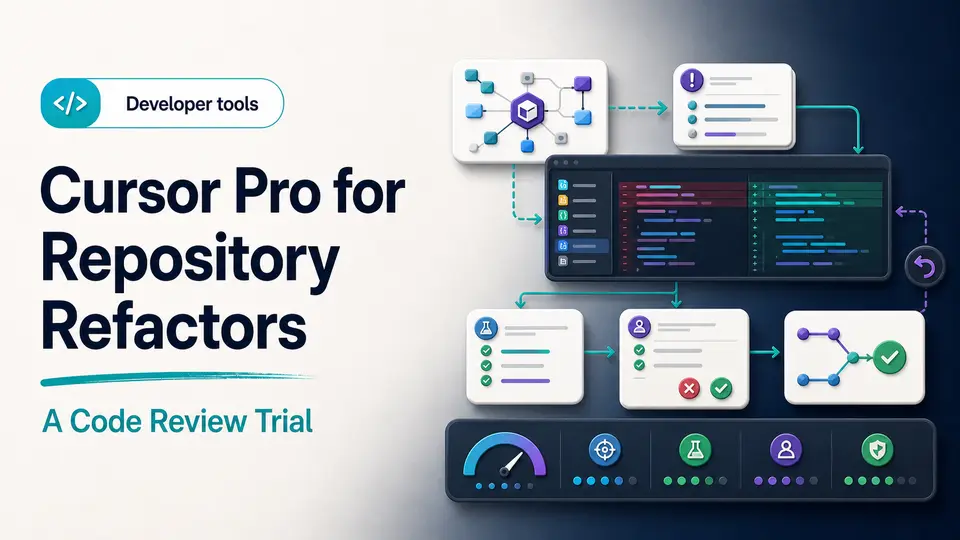
A maintainer wants to move authorization checks out of three route handlers and into a shared policy module. The change looks repetitive, but it crosses imports, tests, error handling, and a security boundary. An AI editor can draft the mechanical part quickly; the real question is whether its patch preserves behavior and remains understandable after a human reviewer inspects every affected file.
Cursor Pro should therefore be evaluated as part of a delivery system, not as a typing contest. A useful trial measures repository orientation, patch quality, test results, review time, regressions, and long-term clarity. It also confirms the provider's current privacy controls and purchase route before private code is shared or a subscription is attached to the wrong account.
The short answer
- Use a bounded, non-sensitive refactor with objective acceptance tests and a clean rollback path.
- Measure the final reviewed patch, including rejected edits, debugging, regressions, and documentation work.
- Purchase Cursor only through the official provider route and confirm privacy settings before sharing code.
Choose a bounded refactor with an observable result
Select a change that is meaningful enough to exercise repository context but small enough to inspect completely. Good candidates include consolidating duplicate validation, extracting an internal adapter, replacing a deprecated API, or adding a focused test seam. Write the acceptance criteria before opening the editor: current tests must keep passing, new edge cases must be covered, public behavior must remain stable, and the final design must be easier to explain than the starting point.
Avoid using a live incident, a secret-heavy repository, or a migration with no rollback as the first trial. Establish a baseline from a similar change completed without assistance, including discovery, implementation, tests, review, and follow-up. The comparison is only useful when both paths include the same quality gates. A five-minute draft compared with a fully reviewed manual change exaggerates the benefit and hides the cost that appears after generation.
- Freeze the scope and acceptance criteria before generating code.
- Use a branch with a clean diff and an explicit rollback point.
- Record baseline time for orientation, implementation, tests, and review.
- Exclude secrets, regulated data, and repositories not approved for the trial.
Map repository context before accepting edits
Ask the editor to explain the dependency path, nearby conventions, test locations, and public behavior before requesting a patch. Compare that explanation with the repository itself. Missing a second implementation, generated file, feature flag, or authorization wrapper is an early warning that the model's working map is incomplete. Correct the context first rather than asking for a larger diff and hoping review will reveal the omission later.
Provide stable project instructions that define formatting, test commands, dependency rules, and files that must not change. Keep prompts outcome-focused: state the invariant, the permitted surface, and the verification command. Do not paste credentials or unrelated proprietary material. When the task needs information outside the repository, supply the smallest approved source and preserve a link so a reviewer can distinguish project evidence from model inference.
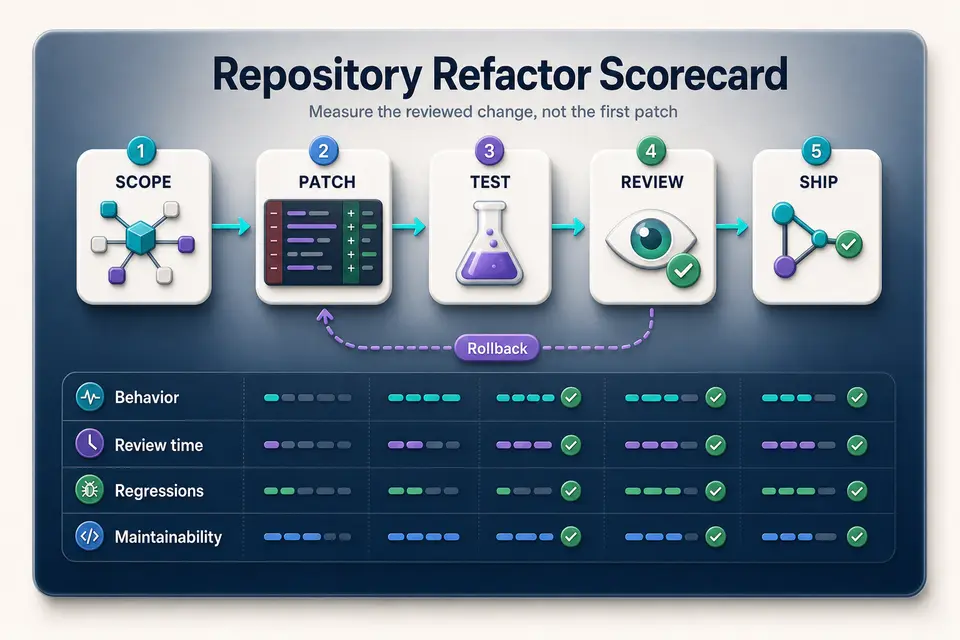
A fast multi-file patch has no productivity value until the tests pass, the reviewer understands it, and the team is willing to own it.
Taploop decision principle
Generate small, reviewable patches
Ask for one logical change at a time and inspect the diff before continuing. A useful sequence is to add characterization tests, introduce the new abstraction, move one caller, run checks, and then migrate the remaining callers. Smaller patches expose misunderstandings early and make rollback straightforward. They also prevent an appealing final architecture from obscuring a subtle behavior change buried in dozens of files.
Read every changed line and every deleted line. Check error paths, null and empty inputs, concurrency, authorization, logging, and compatibility with existing data. Treat generated comments and test names as claims that need confirmation. If the tool repeatedly rewrites unrelated code or cannot explain an import boundary, narrow the task or finish manually; more prompting is not automatically cheaper than direct engineering.
- Prefer a sequence of reversible diffs over one repository-wide rewrite.
- Inspect deletions and moved behavior as carefully as new code.
- Reject unrelated formatting, dependency, or configuration changes.
- Save the final human-approved diff, not the amount of generated code.
Run the delivery scorecard
Execute the same checks your team requires for a human-written change: focused tests, full relevant suites, type checks, linting, security analysis, dependency review, build verification, and a manual scenario when automation cannot cover the behavior. Record failures caused by the patch separately from unrelated baseline failures. Count time spent diagnosing misleading fixes, restoring deleted behavior, and correcting tests that merely mirrored the implementation.
Score four outcomes. Behavior asks whether the accepted criteria and edge cases still hold. Review time captures the effort needed to understand and trust the diff. Regressions include defects found before and after merge. Maintainability asks whether another developer can extend the result without reconstructing the conversation. A fast patch that lowers any of those outcomes may be useful as exploration, but it has not yet demonstrated production value.
Confirm privacy, account, and organization policy
Cursor's current security information says Privacy Mode can be enabled by individual users and enforced for teams, and describes controls intended to prevent code data from being used for training when that mode is active. Review the current settings and documentation for the exact account before connecting a private repository. Privacy language does not replace your employer's approval, contractual requirements, repository classification, or rules for subprocessors and remote agents.
Decide which account should own the subscription, configuration, billing, and recovery. A personal trial is not a shortcut around a team licensing decision. If the workflow uses cloud or background agents, examine the additional execution and retention implications rather than assuming local-editor behavior applies. Document what was permitted in the test so a favorable result can be reproduced without quietly expanding the data boundary.
Respect the provider's purchase boundary
Cursor's current official pricing page states that subscriptions are sold directly through cursor.com and that it does not authorize resellers or third-party sellers. That statement is decisive: use Taploop's product research to understand the category and compare workflows, but do not treat a marketplace listing as an approved way to acquire Cursor. Recheck the official page because plan names, limits, prices, and purchase rules can change.
Compare the result with GitHub Copilot when the main question is repository delivery rather than editor preference. Keep the decision evidence-based: which tool understood the project, produced the smaller correct diff, required less review, and integrated with the team's identity and policy controls? If neither trial improves reviewed delivery, keep the existing workflow and revisit the choice when the repository, team, or provider capabilities change.
The verdict
Verdict: useful when the reviewed refactor is safer and faster
Cursor Pro is easiest to justify when a developer can demonstrate faster repository orientation and smaller correct patches without increasing regressions or review burden. The strongest evidence is a repeatable trial whose acceptance tests, final diff, human review notes, and maintenance outcome are preserved. An impressive first edit is only a starting point; the product earns its place when the team can ship and own the result.
If the trial succeeds, confirm the current plan, account, privacy mode, organization policy, usage allowance, and official direct-purchase terms. Do not buy Cursor through an unauthorized marketplace route. Taploop can still help compare adjacent tools and organize the decision, but provider authorization and repository governance remain hard boundaries rather than details to resolve after payment.
Product guide
Need the complete Cursor Pro guide?
Review product capabilities, platforms, official sources, and the current Taploop buying path in one place.
Compare before you choose
These comparison and category pages help you review nearby products and tradeoffs before choosing.
Continue with a related workflow
These nearby articles cover other practical questions about cursor pro repository refactor test that you may want to explore next.

Ready to review Cursor Pro?
Check the product page for the currently published plan, term, account, region, renewal, price, and remedy details. Purchase controls appear only when the required offer data and inventory are present.
Frequently asked questions
What is a good first Cursor Pro test?
Choose a bounded refactor in a non-sensitive repository with clear acceptance criteria, existing tests, and a rollback path. Include repository orientation, patch generation, focused and full checks, human review, and final documentation. Avoid a live incident or broad migration because the result will be hard to attribute and unsafe to learn from.
Should I measure generated lines of code?
No. Generated volume rewards larger patches and says nothing about correctness. Measure time to a reviewed change, rejected edits, test failures, security findings, regressions, and whether another developer can maintain the result. The final accepted diff matters; discarded output is part of the cost.
Does Privacy Mode make every repository appropriate?
No. Review Cursor's current documentation and account settings, then apply your organization's repository classification, client agreements, security review, and approved-tool policy. Privacy Mode is an important control, but it does not grant permission to upload code or use remote agents where another policy prohibits it.
Can I buy Cursor Pro from a reseller?
Cursor's current official pricing page says subscriptions are sold directly through cursor.com and that third-party sellers are not authorized. Recheck that page on the decision date and purchase only through the provider route it identifies. A Taploop comparison or catalog page should not be interpreted as an authorized Cursor checkout.
How does this test differ from the GitHub Copilot guide?
This workflow focuses on an editor-centered multi-file refactor, repository context, rollback, and privacy settings. The Copilot guide measures issue-to-delivery performance across GitHub and supported development surfaces. Run comparable tasks when you need a decision, then choose the tool that improves reviewed delivery within your identity and governance requirements.
Official sources reviewed
Product plans change. These provider sources were checked on July 19, 2026; review them again when you make a purchase decision.