
A policy analyst receives a seventy-page consultation paper, three supporting appendices, and a request for a briefing by the next afternoon. Claude can help map the arguments and surface passages to review, but a polished summary is only useful when the analyst can trace every important claim back to the source and correct what the system missed.
That situation captures the real buying decision. Claude Pro may be valuable for sustained work with documents, projects, writing, or code, yet the subscription does not replace subject expertise or create a fixed amount of usable output. The sensible test is whether the current plan improves your own long-context workflow after revision and verification, on an account whose ownership and provider eligibility are clear.
The short answer
- Value Claude Pro against long documents, sustained projects, and other recurring work.
- Usage varies with message length, attachments, model choice, and provider policy.
- Verify the account and entitlement path before treating any marketplace listing as usable.
Start with Claude Pro's best-fit workflows
Claude Pro is most useful when your work involves sustained context: reviewing a long document, developing a careful draft, comparing source material, or working through a software task over several steps. A buyer should test those exact jobs rather than subscribe because a benchmark or social post says one model is best.
Build a small evaluation set from your own work. Include a routine task, a difficult task, and a task where an incorrect answer would be costly. Compare the quality of the first result, the revision effort, and the time required to verify it. That produces a much better answer to whether Claude Pro is worth it for you.
- Long-form writing with a clear brief and reference material.
- Document analysis where the original source remains available for checking.
- Research summaries that require opening and reviewing citations.
- Coding assistance backed by tests, version control, and human review.
Understand the current capabilities and limits
Anthropic's current Claude Pro information describes more usage, additional model access, projects, research features, and supported coding workflows than the free plan. It also explains that limits still apply and that capacity can vary. Large files and long conversations can consume allowance differently from short questions.
Check Claude Pro plans at the official provider source before deciding. Confirm the interfaces you intend to use, whether a feature is included in your region, and whether your workload fits the current limits. Anthropic API usage is separate from the consumer subscription, so do not count developer credits as part of a Pro offer.
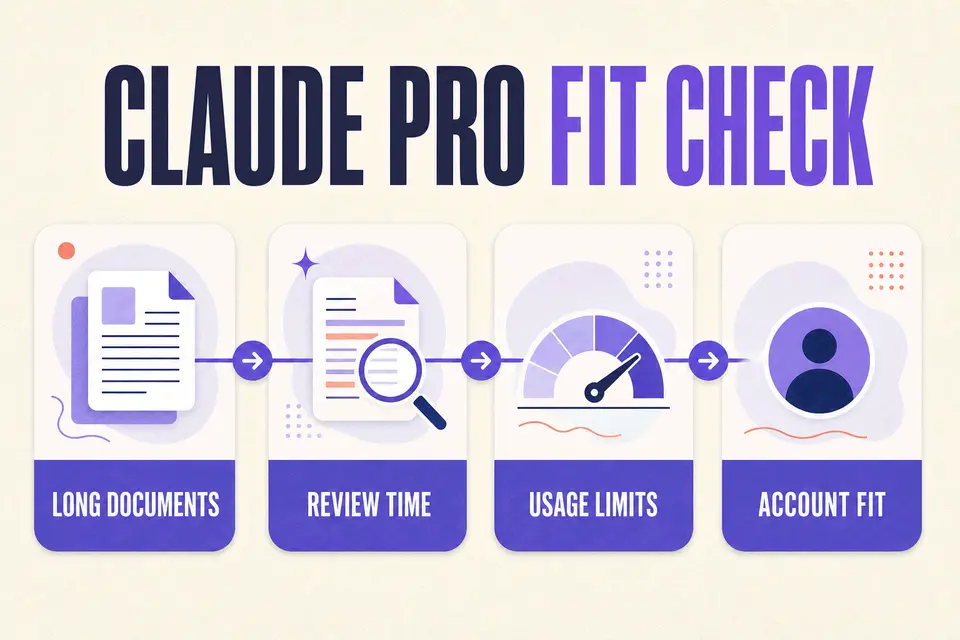
A buyer should test those exact jobs rather than subscribe because a benchmark or social post says one model is best.
Taploop decision principle
Score three real tasks instead of one impressive demo
Use a routine task to measure everyday efficiency, a difficult task to expose reasoning and revision needs, and a high-consequence task to reveal the cost of verification. Keep the prompt, source set, acceptance criteria, and final human-approved output so the test can be repeated when a model or plan changes. A fair test measures the entire path from preparation to approval.
For each task, score the first draft, the number of corrective turns, whether important source material was overlooked, and how long a knowledgeable person spent checking the result. For code, add tests and review the diff. For research, open the cited material. For writing, compare the final voice and accuracy with your normal standard. The winning result is the one that reduces verified effort, not the one that sounds most confident.
- Routine: repeatable work where a small saving can accumulate each week.
- Difficult: a task that needs sustained context, judgment, and several revisions.
- High consequence: work where an unsupported claim or faulty change has a real cost.
- Decision: compare approved output and review time with your existing method.
Check the account and activation path
Decide which email and sign-in method should own the plan. If your work belongs to an employer or team, confirm whether an individual account is appropriate and who should retain project history and billing records. An attractive term is not useful if the entitlement lands in the wrong workspace.
On Taploop, review the product page for the published access method, term, region, renewal treatment, and remedy information. The page may withhold checkout when those facts or inventory are incomplete. That pause protects the buying decision; it should not be read as a promise that every displayed product is currently purchasable.
Recognize when a Pro subscription is a poor fit
Claude Pro may add little value when the work is occasional, short, or already handled well by the current free experience. It may also be inappropriate when an employer requires centralized administration, a different data arrangement, or organizational controls that an individual plan does not provide. A consumer subscription should not be stretched into a team procurement decision merely because the checkout is simpler.
The plan is also separate from Anthropic's API. If the actual goal is a product integration, repeatable automation, or programmatic usage, scope that project independently. If the task is primarily live web discovery or produced voice, a more specialized tool may remove the bottleneck more directly. Choosing not to subscribe is a valid result when the evaluation set shows little improvement after checking and revision.
Compare alternatives and finish the buyer checklist
ChatGPT Plus is the closest broad assistant comparison, while Perplexity Pro is a more focused research option. ElevenLabs serves a different job when the final output is a produced voice rather than text or analysis. Choose the workflow first, then compare product boundaries.
Before checking a Claude Pro offer, verify the exact plan, duration, account ownership, included surfaces, usage expectations, renewal behavior, region, and support path. Save the provider documentation you relied on and read the final order terms again before payment.
The verdict
Verdict: a strong candidate for sustained, reviewable work
Claude Pro is most defensible for people who regularly work through long documents, multi-step writing, analysis, or code and can measure a reduction in approved-work time. It is less compelling for occasional prompts, tasks with little context, or organizations that need managed ownership and policy controls. The subscription should earn its place by improving a repeatable evaluation set rather than by winning a general model comparison.
When the workflow test is positive, confirm the current provider plan and the intended account before reviewing a Taploop offer. The plan, duration, access method, account ownership, region, renewal behavior, final total, and remedy information should be published and internally consistent. If the entitlement path or organizational fit remains unclear, resolve that issue before payment or choose a route designed for the required workspace.
Product guide
Need the complete Claude Pro guide?
Review product capabilities, platforms, official sources, and the current Taploop buying path in one place.
Compare before you choose
These comparison and category pages help you review nearby products and tradeoffs before choosing.
Continue with a related workflow
These nearby articles cover other practical questions about claude pro long document workflow that you may want to explore next.

Ready to review Claude Pro?
Check the product page for the currently published plan, term, account, region, renewal, price, and remedy details. Purchase controls appear only when the required offer data and inventory are present.
Frequently asked questions
Is Claude Pro unlimited?
No. Anthropic documents usage limits, and the practical allowance can depend on message length, attachments, selected capabilities, and current capacity. Test a representative workload and review the provider's current usage guidance rather than converting an old review into a promised number of projects or documents.
How should I test Claude Pro before paying?
Build a three-task set from your own work: one routine, one difficult, and one high-consequence task. Keep the sources and acceptance criteria fixed, then measure first-pass quality, corrections, verification time, and the final approved result. Do not use confidential material unless its use is permitted and the applicable data controls are understood.
Does Claude Pro include Anthropic API usage?
No. Consumer-plan access and API billing are separate. A software integration needs its own architecture, security review, usage estimate, and billing plan. Do not buy a consumer subscription on the assumption that it supplies developer credits or a transferable entitlement for an application.
Who should own the Claude account?
Use an account appropriate for the person or organization that should control billing, recovery, project history, and the resulting work. Employer or client material may call for a managed workspace or different plan. Decide ownership and handoff before creating projects that will need to survive a role or vendor change.
What should a Taploop Claude Pro offer specify?
The offer should identify the exact plan, term, account and access path, region, renewal treatment, provider requirements, final total, and remedy terms. Availability should not be inferred from an editorial guide. Proceed only when the live product page publishes the required offer data and enables its purchase controls.
Official sources reviewed
Product plans change. These provider sources were checked on July 18, 2026; review them again when you make a purchase decision.