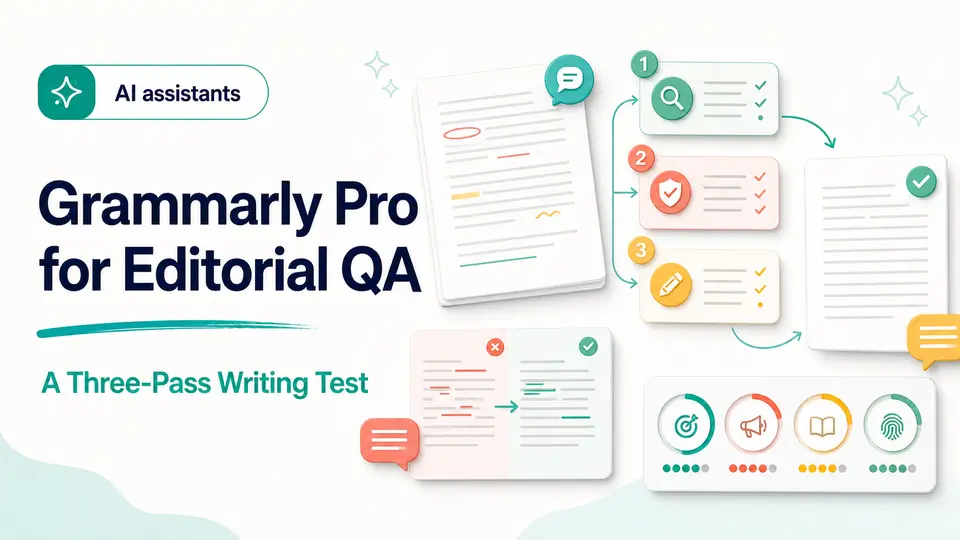
An editor receives a product brief that is grammatically clean but strategically weak. The opening overstates a result, two facts have no sources, the tone shifts from formal to promotional, and an automatic rewrite makes the most important limitation less precise. A writing assistant can reveal friction quickly, yet accepting every suggestion would create a smoother document that is less trustworthy.
Grammarly Pro is best evaluated as one layer in editorial quality assurance. The tool may improve clarity, tone, consistency, and originality checks, but it does not own the facts, the house style, or the final decision. A practical test separates three passes—clarity, accuracy, and voice—then measures the approved document rather than the number of green checks shown during editing.
The short answer
- Separate clarity, accuracy, and voice so a stylistic rewrite cannot hide a factual problem.
- Compare the final approved document with a baseline, including review time and introduced errors.
- Confirm account ownership, feature controls, data policy, and the exact live plan before purchase.
Build an editorial test set with known problems
Choose three documents that resemble the work you publish: a routine email or update, a customer-facing article, and a higher-consequence policy, proposal, or report. Preserve the original and create a short answer key identifying factual claims, required terminology, intended audience, sensitive language, citation needs, and phrases that must not change. Include a few sentences that are technically correct but hard to read, plus a few that are polished but unsupported.
Complete one document with your normal process to establish a baseline. Record editing time, reviewer comments, corrections after review, and any errors found after publication. The assisted test must reach the same approval standard. Counting only the time until the suggestion panel is clear rewards superficial cleanup and excludes fact-checking, stakeholder feedback, and the decisions that determine whether the copy is safe to use.
- Use routine, public-facing, and higher-consequence samples.
- Write down facts, terms, audience, and non-negotiable meaning first.
- Preserve untouched originals and the final approved versions.
- Measure full approval time, not time to clear suggestions.
Pass one: improve clarity without changing meaning
Review grammar, sentence structure, repetition, and readability first. Accept a suggestion only after comparing it with the original claim and surrounding paragraph. Automatic rewrites can remove a qualifier, flatten a distinction, or make a cautious statement sound certain. Read the revised passage aloud and ask whether the same person, action, time period, and degree of confidence remain intact.
Track the suggestions you reject and why. A high rejection rate around product names, technical terms, inclusive language, or regulated phrases may indicate that the style context is incomplete. Add approved terminology or a style guide where the plan and organization support it, then rerun the sample. The value is not a universal rewrite; it is fewer avoidable corrections while the author remains in control of meaning.
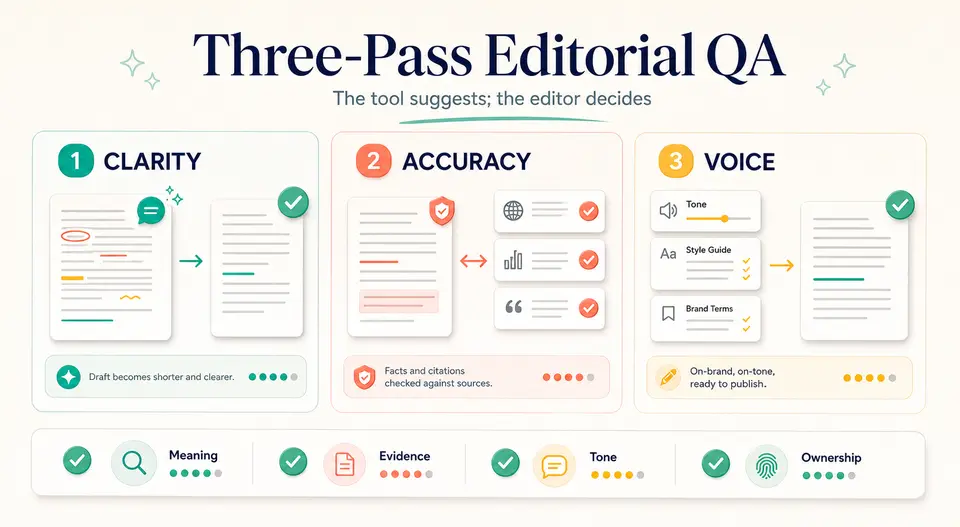
The goal is not to accept more suggestions; it is to publish a clearer document whose meaning, evidence, and voice still belong to the author.
Taploop decision principle
Pass two: verify facts, citations, and originality
Freeze stylistic editing and examine every factual statement. Open the original sources, check dates and scope, reproduce important calculations, and verify names, quotations, and links. A writing assistant can identify awkward phrasing or highlight text for further review, but it cannot make an unsupported claim true. When generative features add an example, statistic, or explanation, treat that material as a new claim that requires the same evidence as author-written copy.
Grammarly's current support pages describe plagiarism checking and AI-detection features in several paid product surfaces. Use those results as signals, not verdicts. Similarity may be legitimate and detection can be uncertain. Inspect matched material, confirm quotation and citation requirements, follow the publisher's policy, and document the human decision. Originality review should protect authorship and attribution without pretending an automated score can determine intent.
- Open the source behind every consequential claim.
- Recheck numbers, dates, names, links, quotations, and jurisdictions.
- Treat generated additions as unverified until evidence is attached.
- Use plagiarism and AI indicators as review leads, not automatic judgments.
Pass three: restore voice and audience fit
Read the document from beginning to end after the sentence-level corrections. Check that the tone fits the audience, transitions still make sense, and the writer's priorities remain visible. A page can become uniformly polished and still lose its energy, authority, or empathy. Compare a few key paragraphs with the untouched draft and restore intentional rhythm, technical specificity, or human language that the editing pass made generic.
For team work, test shared style guidance against real exceptions. Brand terms and tone controls can reduce repeated corrections, but someone must own the guide, approve changes, and resolve conflicts between brand consistency and subject accuracy. Note which suggestions improved the document, which needed customization, and which categories should remain under specialist review. That record is more useful than an undifferentiated acceptance percentage.
Review privacy, account ownership, and team controls
Decide what kinds of text may be processed before installing an extension or uploading documents. Exclude passwords, protected personal data, confidential drafts, legal material, or client content unless the use is authorized and the current provider terms and controls meet the requirement. Grammarly's privacy information describes data handling and service providers, but your organization still needs to evaluate the exact product surface, device, retention needs, and contractual context.
Grammarly currently describes Pro as serving individuals and teams, with collaboration features and administrative controls that differ from some other plans. Confirm who should own the subscription, invite members, manage style resources, control generative features, receive billing notices, and recover the account. A shared personal login is not a safe substitute for managed membership, and a personal mobile subscription may not include the same team capabilities as a web-purchased Pro plan.
Score the plan and verify the offer
Compare baseline and assisted documents on approved editing time, factual corrections, reviewer comments, consistency, voice preservation, and errors introduced by suggestions. Also count how often the tool interrupts work with low-value signals. Grammarly Pro is easier to justify when recurring editorial volume is high and the workflow removes repeat corrections without shifting more work into fact-checking or voice repair. Occasional writers may find that the existing free or platform-level tools already cover the meaningful need.
Check Grammarly's current official plan information for the exact features, prompt allowance, billing cadence, devices, and team scope. Then inspect any live Taploop offer separately for plan identity, account path, seats, term, region, renewal treatment, final total, and remedy terms. If a listing cannot distinguish Pro from Premium, Plus, Business, or another current product, do not infer entitlement from the brand name alone.
The verdict
Verdict: valuable when it strengthens an accountable editing process
Grammarly Pro is easiest to justify for people or teams that edit a steady volume of important writing and can show fewer repeated corrections after a full approval cycle. The three-pass test protects the document from a common failure mode: improving surface fluency while weakening meaning, evidence, or voice. The final editor remains responsible for what the document says and why it is ready to publish.
If the benchmark succeeds, confirm the current provider plan, devices, team controls, account ownership, generative allowance, privacy requirements, and billing terms. Then verify that the live Taploop offer describes the same entitlement with explicit access and remedy details. A useful editorial workflow and a clear offer should support one another; neither is permission to skip the other.
Product guide
Need the complete Grammarly Pro guide?
Review product capabilities, platforms, official sources, and the current Taploop buying path in one place.
Compare before you choose
These comparison and category pages help you review nearby products and tradeoffs before choosing.
Continue with a related workflow
These nearby articles cover other practical questions about grammarly pro editorial qa test that you may want to explore next.
Frequently asked questions
What is the three-pass Grammarly Pro test?
Pass one reviews clarity while protecting meaning. Pass two verifies facts, citations, and originality. Pass three restores voice, audience fit, and brand context. Preserve the original, measure the entire approval cycle, and compare the final document with a normal editing baseline rather than counting accepted suggestions.
Does Grammarly replace a human editor?
No. It can surface language, tone, consistency, and originality signals, but a human must judge meaning, factual support, audience, legal or policy requirements, and final ownership. Higher-consequence material may also require a subject expert, legal reviewer, or publisher-specific process beyond general editorial assistance.
How should I use plagiarism or AI-detection results?
Treat them as leads for human review. Open matched sources, inspect quotation and citation needs, apply the publisher's policy, and avoid assuming a score proves intent or authorship. Detection can be uncertain, and legitimate language may resemble published material. Document the evidence and decision instead of automating an accusation.
Is Grammarly Pro the same as every other Grammarly plan?
No. Grammarly's current support information distinguishes web-purchased Pro from Premium and other individual, team, business, education, or suite offerings. Features, prompt allowances, administration, billing, and platform availability can differ. Check the official plan page for the exact product and account you intend to use.
What should a Taploop Grammarly Pro offer specify?
Look for the exact plan, individual or team scope, seats if applicable, account and access path, included features, term, region, renewal treatment, final total, and remedy terms. Purchase controls should appear only when required offer data and inventory are present. Do not infer Pro entitlement from a generic Grammarly label.
Official sources reviewed
Product plans change. These provider sources were checked on July 19, 2026; review them again when you make a purchase decision.